
How Does a Throttling Valve Work?
Throttling valves are essential components used to control flow rate, pressure and speed. In pneumatic systems, they allow air to pass through steadily and precisely that ensures the safe and efficient operation of equipment.
How do throttling valves work? We hear this question from many people. This article will explore throttle valve function, the types, applications and how to choose the best throttling valve. Read on to learn everything you need to know about these valves.
What is a Throttle Valve?
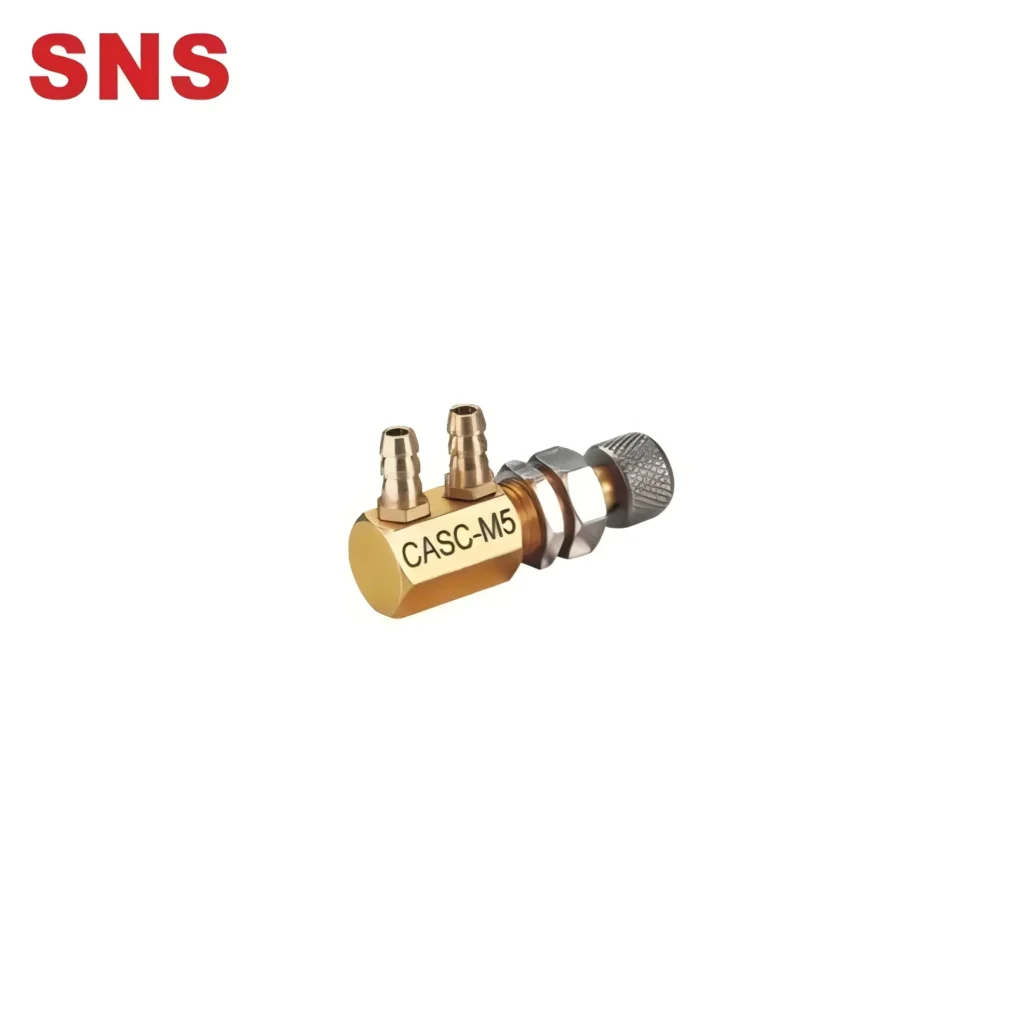
A throttling valve is a device used to control the flow rate of fluids within the system. By adjusting the valve position, the operator can regulate the flow rate, pressure and temperature of the fluid that achieve precise control of the process.
How Does a Throttling Valve Work?
A throttling valve actively increases local flow resistance through an internally adjustable narrow channel that forces a significant pressure drop in the fluid at this point. Thereby it makes precise control over downstream parameters.According to Bernoulli’s principle, during this process the flow velocity increases sharply at the throttling point and some of the fluid’s pressure energy is converted into kinetic and thermal energy that result in irreversible energy loss. Therefore, throttling is essentially an energy-consuming process that uses valves to adjust parameters.
Types of Throttle Valves
1. Globe Valve: Globe valve is one of the most common types of throttle valve. It features a movable disc or plug that moves perpendicular to the flow direction that creates a variable restriction. Globe valve achieves excellent flow control and is suitable for applications requiring precise regulation.
2. Needle Valve: Needle Valve adopts the minute movement of a conical needle-shaped valve core to change the area of a small flow channel. This valve offers excellent fine-tuning capabilities and is specifically designed for applications requiring extremely precise control of small airflows such as instrumentation and measurement circuits.
3. Butterfly Valve: Butterfly valve composes of a circular disc mounted on a rotating rod inside the pipe. Flow can be controlled by changing the alignment of the disc with the flow direction as the disc rotates. This valve is cost-effective and commonly used in large-diameter pipelines.
4. Ball Valve: Ball valve uses a spherical closing element to control flow. The operator can change the flow area by rotating the ball to achieve efficient control. Ball valves are known for their rapid closing capability and are often used in applications requiring on/off control and throttling.
5. Sliding Stem Valve: Sliding valve is a multi-functional throttle valve that uses a sliding valve to control flow. It comes in various configurations that include ball, angle and three-way valves. Its flexibility makes them suitable for a wide range of applications.
6. Diaphragm Valve: Diaphragm valve uses a flexible diaphragm to control flow. When the diaphragm is pressed against the seat, it blocks fluid flow; releasing it allows fluid to pass through. This valve is ideal for applications requiring tight closure and is commonly used in the pharmaceutical and food industries.
Throttling Valve Applications
1. Automation & Manufacturing: In automated production lines, throttle valves are commonly used to control cylinder speed that make machine operation smoother and safer.
Typical application: Robotic arm speed regulation
2. Automotive Industry: In the automotive industry, throttle valve includes both pneumatic throttle valves and the throttle body in the engine system.
Main applications include: idle throttle valve for regulating idle air volume, throttle valve function for controlling engine power and exhaust throttle valve for optimizing exhaust back pressure.
3. Chemical & Process Industry: Chemical production requires stable flow and pressure control; throttling valves are used to maintain the smooth operation of piping systems.
Typical applications: Flow regulation, pressure control, process throttling
4. Food & Beverage Industry: Food manufacturing requires precise pneumatic actuation and hygienic conditions.
Typical applications: Packaging line pusher cylinder speed regulation, pneumatic control of testing equipment
5. Energy & Power Generation
In energy systems, throttle valves are used to regulate the flow of air, steam or gas.
Typical applications: Boiler gas supply regulation, combustion system air control and turbine auxiliary control loops
6. Medical Equipment
Many medical devices have stringent requirements for gas flow rates that necessitate the use of high-precision throttle valves.
Typical applications: Ventilator gas flow regulation, anesthesia machine gas control and medical air tubing regulation
7. Environmental & Water Treatment Industry: Throttling valves are used to manage air or liquid flow rates that ensure stable operation of treatment systems.
Typical applications: Wastewater treatment aeration regulation and factory exhaust emission control
8. Logistics & Packaging Industry: Pneumatic systems are ubiquitous in packaging and logistics equipment. Throttling valves help equipment achieve smooth operation that avoid shocks and damage.
Typical applications: Automatic carton sealing machines, sorting lever cylinders, packaging push mechanisms and conveyor buffer action control.
What is the Difference Between Throttle Valve and Flow Control Valve?
| Item | Throttle Valve | Flow Control Valve |
| Control Method | Change the size of the orifice | Precise flow control, either automatically or manually |
| Accuracy | Normal | Higher |
| Feature | Simple structure and low cost | It can be controlled in one direction and has better stability. |
| Common Scenarios | Adjust cylinder speed | Control precise flow |
If your system pressure is stable or only requires coarse adjustment, a throttle valve is sufficient and economical; if precise and stable flow is required, unaffected by pressure fluctuations, a flow control valve must be selected. The two are often used in combination to achieve more stable operation.
Throttling Valves & Pump Corrosion Issues
The operation of throttling valves is closely related to pump corrosion. Excessive or improper throttling can lead to:
Cavitation corrosion
1. Throttling and sudden pressure drop: When the valve opening, especially the valve installed at the pump outlet, is reduced, the fluid flows through the narrow channel and the flow velocity increases sharply. According to Bernoulli’s principle, the local static pressure at this point will drop sharply.
2. Bubble generation and collapse: If the pressure drops below the saturated vapor pressure at the fluid temperature, the liquid will “boil” and generate a large number of vapor bubbles. When these bubbles enter the high-pressure zone within the pump, the surrounding high-pressure liquid rapidly crushes them. It will cause the bubbles to collapse instantly.
3. Microscopic Water Hammer and Corrosion
Mechanical Damage: The micro-jet generated when bubbles collapse impacts the metal surface at extremely high pressures (up to thousands of atmospheres). Repeated impacts act like “miniature water hammers,” directly peeling away the metal material and forming honeycomb-like or sponge-like pitting corrosion.
Chemical Acceleration: This impact simultaneously damages the passivation layer or protective film on the metal surface, exposing fresh, reactive base metal directly to the corrosive fluid that greatly accelerates the electrochemical corrosion process.
Exacerbating Erosion Corrosion
1. Dramatic Increase in Flow Rate: Throttling causes pressure drop and results in extremely high flow rates through the valve core and downstream local pipes.
2. Destruction of Protective Layer: High-speed fluid or solid particles carried in the fluid continuously scour the surface of the pump’s flow components. This mechanical scouring wears away or destroys the corrosion product layer or coating on the metal surface.
3. Vicious cycle of corrosion and wear: After the protective layer is removed, the new metal substrate is exposed and corrosion occurs immediately; the corrosion products are then carried away by high-speed scouring that result in extremely rapid material loss.
Changing Operating Conditions and Vibration
1. Deviating from the High-Efficiency Zone: Excessive throttling forces the pump to operate in the inefficient zone or near the minimum flow rate for extended periods. This wastes energy and exacerbates backflow and eddies within the pump that cause abnormal vibration and overheating.
2. Accelerated Corrosion Fatigue: Continuous abnormal vibration applies alternating stress to pump components such as shafts, bearings and seals. In the presence of a corrosive environment, components may develop cracks and propagate under stresses far below the material’s yield strength that ultimately lead to fracture.
Find the Perfect Valve Today
If you’re looking for stable, durable and easy-to-maintain valves, SNS Pneumatic offers expert products and technical support. Contact us for customization advice and a quote.
SNS Pneumatic offers a wide range of valves:
