Reed Switch – A Comprehensive Guide
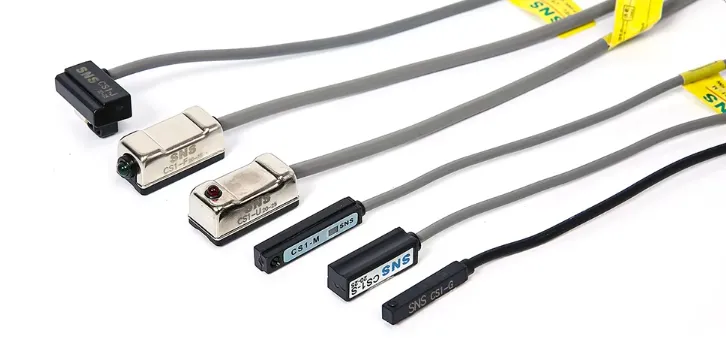
The reed switch is a non-contact electrical switch driven by a magnetic field, which is widely used in pneumatic components, automation equipment, security equipment, instrumentation and other fields. For pneumatic component suppliers, reed switches are one of the most commonly used and core sensor types in cylinder position detection.
This article will outline the characteristics and uses of reed switches to help buyers better understand their working principles.
What Is a Reed Switch?
The reed switch is composed of two magnetic metal reeds sealed in the glass tube. When the external magnet is close, the reeds will attract or separate from each other to output the signal.
Because of its simple structure and high precision, it has extremely high durability and repeatability. In addition, it can be triggered without mechanical contact.
How Does a Reed Switch Work?
The working principle of the reed switch is to use the magnetic field to control the action of the contact. Its internal structure is usually composed of the following parts :
- Metal reed : Two nickel-plated reeds keep a certain distance in the glass tube and are in a non-contact state.
- Sealed glass tube : provide airtight protection for the reed to prevent it from being affected by moisture, oil or dust.
- Magnetic induction : When the magnetic field generated by the magnet or coil is close, the magnetic force will make the reed snap or snap.
The typical workflow of reed switch sensor :
- Magnet close → reed pull → circuit connected ( normally open, NO )
- Magnet away → reed pull → circuit disconnected
The normally closed ( NC ) structure can also be selected to control the signal output according to the demand. Since the normally closed reed switch relies on the magnetic field, the reed switch, magnetic switch, magnetic switch and magnetic proximity switch are all application products based on reed technology.
Main Applications of Reed Switches
Due to its high sensitivity and stability, reed switches have a wide range of applications, especially in the pneumatic industry. The following are some typical application:
Cylinder Position Detection ( core application )
The reed switch is mounted on the outside of the cylinder and used in conjunction with the internal magnetic ring that can accurately detect the piston position.
Automation Equipment
Magnetic proximity switch is used for non-contact detection of the position of moving mechanical parts, which is suitable for automation equipment.
Industrial Control System
The reed switch can feedback the position of the conveyor belt, the manipulator and the reclaiming device in the industrial control system. The spring switch solenoid valve provides feedback monitoring of valve switching action, thereby improving system safety and automation.
Flow Meter and Liquid Level Meter
The reed switch is used to monitor whether the liquid level or flow rate reaches the set value in the flowmeter and the liquid level meter.
Security Equipment
Reed switches often appear in security devices such as door magnetic sensors, window magnetic sensors and alarms.
Advantages of Reed Switches
Compared to mechanical switches or other types of sensors, reed switches have the following recognized advantages :
Non-contact trigger, longer service life
Because its switching action is completely dependent on the magnetic field, there is no direct friction or contact, so the wear is extremely low.
Strong ability to resist environmental interference
The glass sealing structure makes it not affected by dust, oil and moisture and is suitable for harsh industrial environments.
High sensitivity and precise action
Only a very small magnetic force is needed to drive, which is suitable for detection scenarios that require high repeatability.
Simple installation and compact structure
Passive design and no external power supply can be flexibly applied to space-constrained devices.
Low cost and high reliability
It is a cost-effective sensing solution in the field of industrial automation.
Types of Reed Switch
Normally Open (NO) Type
The normally open ( NO ) reed switch remains disconnected due to its own elasticity when there is no external magnetic field. When there is an external magnetic field, the contact is closed and the circuit is connected. This is the most commonly used type and adopts a simple structure with only two pins.
Normally Closed (NC) Type
The normally closed ( NC ) reed switch, due to its special design ( such as preload or magnetic material ), remains closed without an external magnetic field. When there is an external magnetic field, the magnetic force overcomes the elasticity of the reed and disconnects its contacts.
This type of reed switch is relatively rare and the manufacturing process is more complicated. It is commonly used in safety circuits such as normally open circuits, but triggers an alarm or stops the device when a magnetic field is present.
SNS Launches New Magnetic Switches and Magnetic Proximity Switches
Magnetic Switch
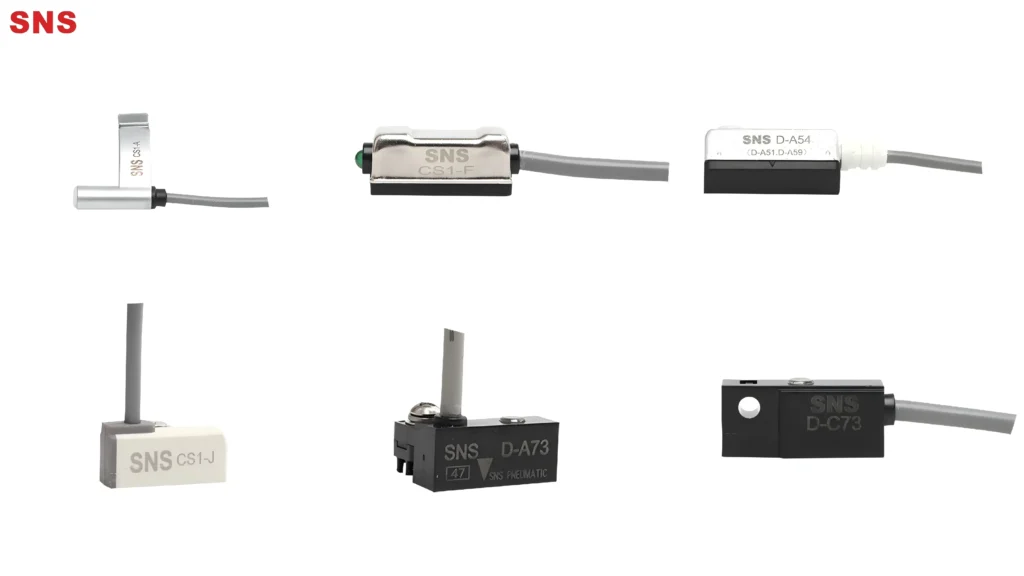
SNS CS1 series reed switch is a magnetic position detection switch designed for cylinders. It can be used in conjunction with the cylinder with built-in magnetic ring to achieve accurate and stable stroke detection.
The operating voltage range of this series of products is 5-240V DC / AC and is equipped with red and green indicator lights that are suitable for various industrial environments.
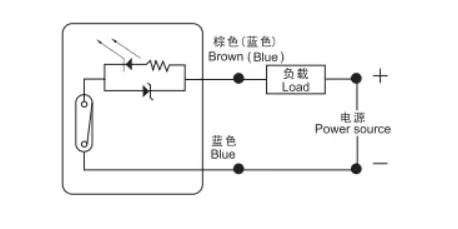
(The SNS CS1 series Reed Switch Wiring Diagram)
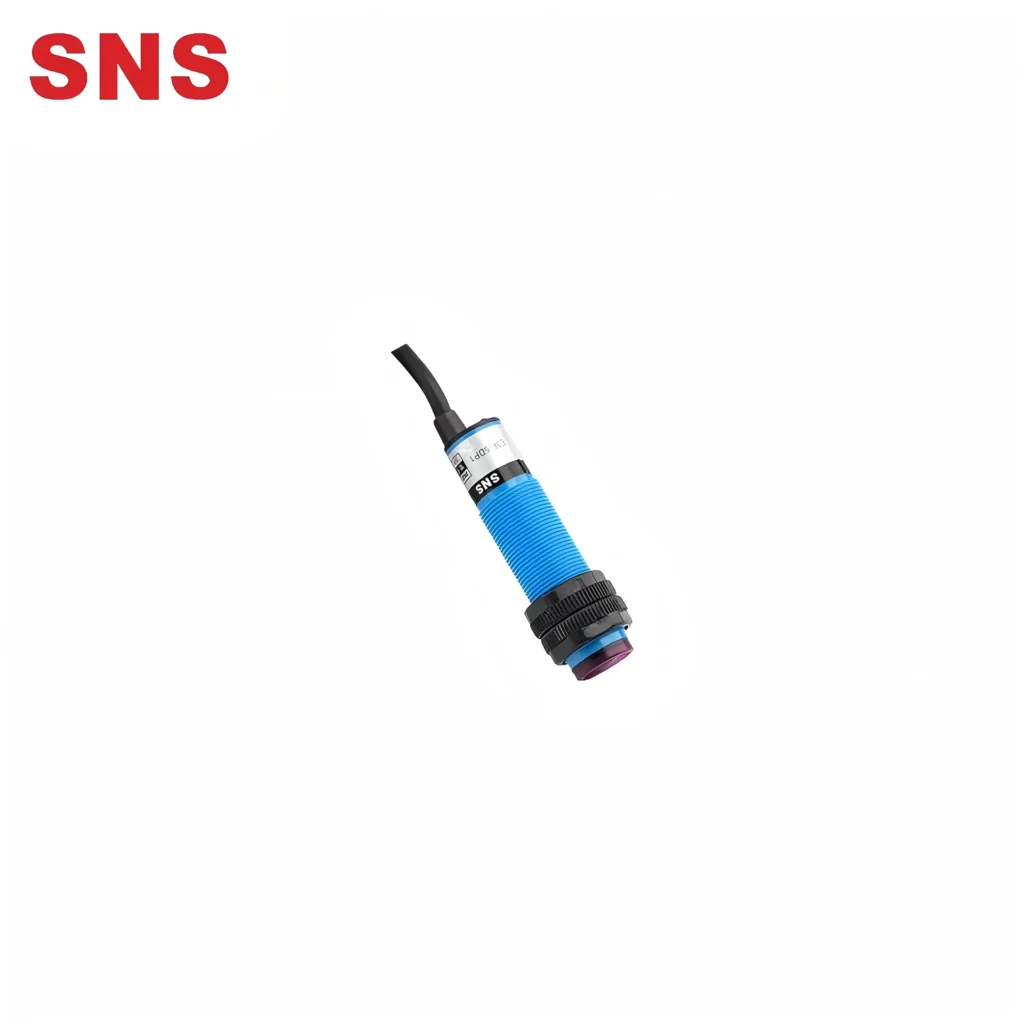
Magnetic Proximity Switch
SNS proximity switch is a position sensor with switch output. It can be connected to a microcomputer ; it can also directly drive electromagnetic relays, counters and contactors to achieve automatic control.
If you want more information, SNS Pneumatic is ready to help you.
How to Choose the Right Reed Switch?
1. Select the model that matches the cylinder specification.
Different brands of cylinder magnetic rings have different positions, so it is necessary to match the appropriate induction distance and installation size.
2. Determine the type of output signal.
Select PNP, NPN, NO or NC types to ensure compatibility with the device control system.
3. Considering the working environment and installation.
If the environment contains oil, water, vibration or metal dust, please choose a model with better sealing performance.
4. Check response speed and service life.
For high-speed equipment, please use a magnetic switch with fast response and high durability.
5. Determine whether the magnetic proximity switch is required in the application scenario.
If a larger sensing distance or higher stability is required, the magnetic proximity switch may be more suitable.
Why Choose a Reed Switch?
When your application scenario meets the requirements of ‘ small load and small vibration ‘, the reed switch is usually the best classic choice. It skillfully uses the simplest physical principles to solve many complex engineering problems.
Whether it is used for cylinder position detection, automation equipment feedback or magnetic proximity detection, reed switches have always been an indispensable core component in the industrial environment due to their high precision, long life and strong anti-interference ability.
What is the difference between a Magnetic Reed Switch and a regular reed switch?
The magnetic reed switch is a reed switch with ‘ magnetic trigger ‘ as the main working principle. In fact, most reed switches are essentially magnetic reed switches ; the difference in name mainly depends on the application field. Both are basically the same in structure and principle.
What is the Difference Between A Magnetic Switch and a Magnetic Proximity Switch?
Both are based on the reed switch principle :
Magnetic switch : mainly used for cylinder position detection ; it is suitable for standard industrial applications.
Magnetic proximity switch : It is more suitable for application scenarios with long detection distance, high automation and high reliability requirements.
The specific selection depends on the installation environment and detection distance.
Which is Better, A Reed Switch or A Hall Sensor?
Reed switch : has no power supply, low cost and strong anti-interference ability that is suitable for simple switch detection.
Hall effect sensor : has fast response and rich output signal that is suitable for integrated electronic systems.
In the pneumatic industry, reed switches are more widely used due to their reliable structure.
How Long is the Lifespan of A Reed Switch?
The mechanical life of high-quality reed switches can exceed one million cycles. Due to its non-contact magnetic trigger design, its actual life is less affected by environmental factors, so it is very suitable for industrial application scenarios that require long-term, high-frequency operation.
How Far can A Reed Switch Detect Distance?
The detection distance depends on the strength of the magnet, the installation direction and the sensitivity of the magnetic spring. It is usually in the range of 1-20 mm, but you can also choose a more sensitive model or use a magnetic proximity switch to increase the detection distance.